
Tag Archives: visual
Zoe Strauss

The tumble of first impressions went something like this: Street photographs. Striking colors. Not that large. In-your-face portraits—faces that looked as worn-out as old rugs, others full of confidence and a beauty rendered more intense by the way that what they were confident of was that the beauty wouldn’t last, so that the confidence too was touched by resignation.
Metabolic Bodies

The title of the group exhibition at David Castillo Gallery, Metabolic Bodies, implies that the strategy of using manipulated readymades is a corporeal action, a chemical change that transforms a substance (in this case found images or objects) into energy.
Russell Maltz, Painted/Stacked 2014 – Conveyance
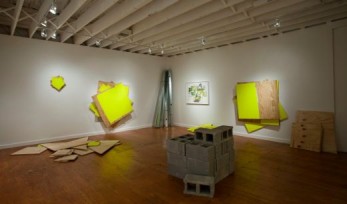
The work of Russell Maltz hovers in the fragile beats between two frequencies. One is the mark-making impulse of the human, while the other is the homogenous system of distribution of the inhuman. In his assemblages of generic building materials—concrete masonry units (cmu), metal studs, PVC pipes, and plywood—there are actions and operations rather than conceptual compositions. Thus the show title situates Maltz’s work as neither self-consciously elevated nor counterproductive.
Jenelle Porter
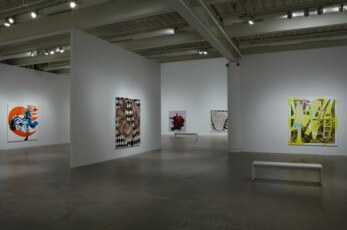
Jenelle Porter is the Mannion Family Senior Curator at the Institute of Contemporary Art/Boston, where she is currently organizing Fiber: Sculpture 1960 – present (October 1, 2014 – January 4, 2015). She spoke at Locust Projects on April 23rd. Soon after, she sat down with The Miami Rail to discuss craft, curating, and Boston.
Miami Drift
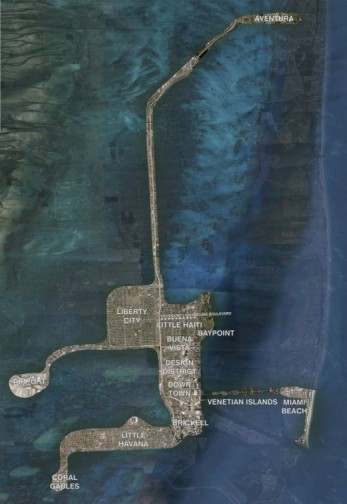
This text could not start in any other way than by emphasizing how the following words are produced by my own subjectivity and built upon a single trip to Miami. Beyond the metaphorical aspect of the cities we visit being islands in an unknown sea, the map (pg. 37) gives the reader, who is likely to know Miami in a much better way than I do, an overview of the neighborhoods that I experienced when I was there.
Kadar Brock
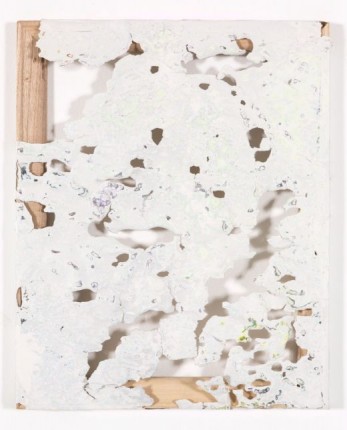
Between 2005 and 2008 I started by exploring the loose, gestural, and expressive idea of abstraction that I saw in the work of German painters like Albert Oehlen and Gerhard Richter, and which I found really appealing. I wanted to use some of the formal things that I saw in their work to try to talk about the content and mythologies that they had painted out of abstraction. Mainly what they got rid of was New Age-y spiritual crap, but I grew up on that stuff because my folks were hippies.
Paola Santoscoy
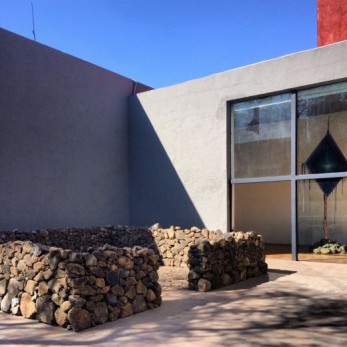
On Sunday, January 9th, I sat down with writer and curator Paola Santoscoy in the VIP room of the Hilton Reforma in Mexico City, the hotel which hosted the first edition of the Material Art Fair. We spoke about the relationship between writing and curating, and the evolution of Mexico City’s contemporary art world.
Designing Complaints
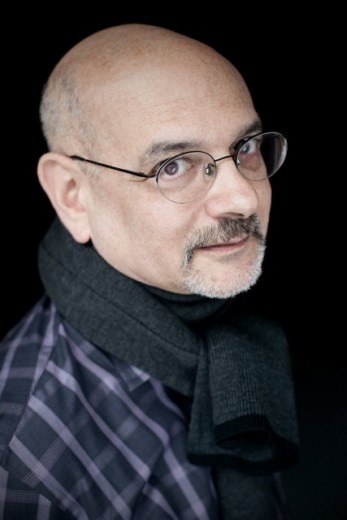
The dumbing down of language. People who stop at the top of escalators. Congress. Global warming. Suspiciously happy individuals. War. Certainty. Smokers. Work. These are a few of the many topics griped about in the 70 or so posters by contemporary artists and designers in the exhibition “Complaints! An Inalienable Right,” curated by noted design critic and ridiculously prolific author Steven Heller (160 books and counting). Heller teaches at the School of Visual Arts, so we took this occasion to quiz him on the poster show, hoping to be taught something about complaints and their purpose.
Public Art In Miami: PortMiami and Beyond
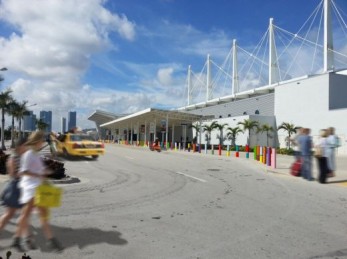
On the occasion of their new public installations at PortMiami, The Rail sat down with artists Bhakti Baxter and Jim Drain, along with Miami-Dade County Department of Cultural Affairs Director Michael Spring, and Art in Public Places Curator Brandi Reddick. The conversation moved from the port to the rest of the city to the ideas surrounding public art in general.
R. Luke DuBois, NOW
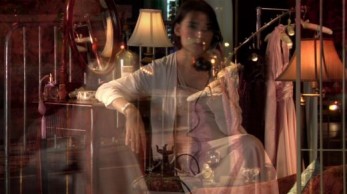
NOW, the survey of artworks by R. Luke DuBois currently on view at The Ringling Museum of Art, is a collection of portraits created from crowd-sourced information. Each originates as data aggregated from sources like Billboard charts, music videos, Manhattan traffic, and the circus. Some portraits consist of complex systems, including his newest, which involves motion-triggered video, and others take on a more traditional identity as flat works recalling the history of the genre. By placing them side by side, curator Matthew McLendon emphasizes transitions both in social ideology and artistic representation.