
Tag Archives: visual
Virginia Poundstone, BOG-MIA
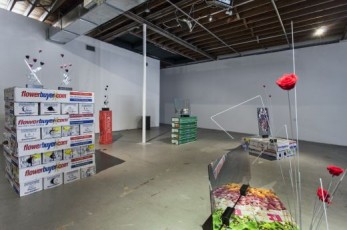
In BOG-MIA, New York-based sculptor Virginia Poundstone cross-pollinates sculpture, video installation, and photography to explore the transformation of flowers from living things to commodities within the global system of trade. The installation is rich in matter and material, incorporating vinyl, granite, aluminum, and chemically altered roses into her work. At the core of Poundstone’s installation is an inherently complicated species, one that yields a complex world beyond its natural state.
Present Tense Future Perfect

Carol Jazzar Contemporary has been slyly nestled in suburbia for six years, offering respite to the white box-weary, art-fair exhausted public. In the semi-plein air environs of a converted garage, one side fully open to the garden, the works are dually lit by sunshine and conventional gallery fluorescence. Neither fully indoors nor outdoors, both physically and metaphysically, the space operates in the liminal present. For the gallery’s winter show, Present Tense Future Perfect, curator Teka Selman has staged a nowhere zone—between unspecified past and insinuated future.
Xaviera Simmons, Open
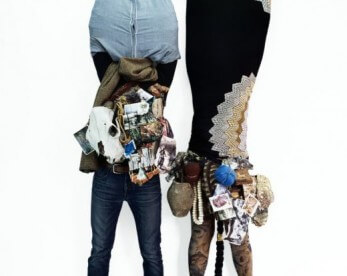
For her new exhibition, Xaviera Simmons splits her practice, roughly, between two physical and intellectual states. Periods of fevered bursts of cultural mining—excavating small truths resident in objects and images found throughout the global landscape—are immediately followed by periods of rest. Specific to the layout at David Castillo’s Wynwood space, Simmon’s Open abandons her comfort zone in terms of curatorial choices and orientation. As every work hangs on the wall, the space morphs into a traditional portrait hall. Large-scale photographs of vaguely human torsos are hung at eye level.
Permission to be Global: Latin American Art from the Ella Fontanals-Cisneros Collection
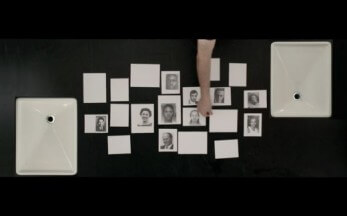
The exhibition consists of an impressive selection of works created between the 1960s and the present, by more than 61 artists from over a dozen Latin American nations, striking a balance between historic precedents and more contemporary manifestations. Divided by four convincing thematic sections, including “Power Parodied,” “Borders Redefined,” “Occupied Geometries,” and “Absence Accumulated,” the exhibition establishes specific points of reference for individual works while flowing compellingly between contexts.
Simulacrum and Simulacrum: Miami Between Itself
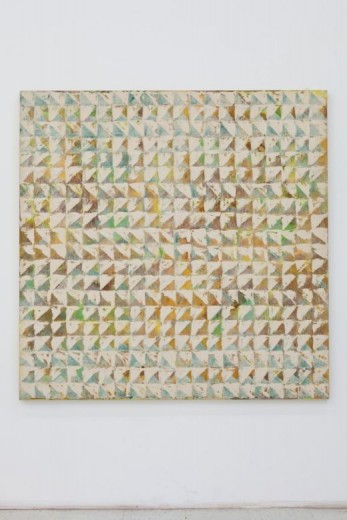
The Miami art scene is charged with a palpable tension. At stake is nothing less than the defining qualities of the developing aesthetic gestalt. This tension can best be conceptualized as a battle of different versions of the “simulacrum,” a term that is as old as Plato and has been contested nearly as long. Though a simulacrum can be described as, roughly, an insubstantial semblance, there is also a possibility of dissimulation that lingers about it, for it replicates a particle of reality not as it is but as it might be. Far from a matter of sterile academic debate, how the Miami art community defines itself in relation to the idea of the simulacrum (and perhaps even as a simulacrum itself) will help define an identity still inchoate.
JPW3, Solid Single Burner
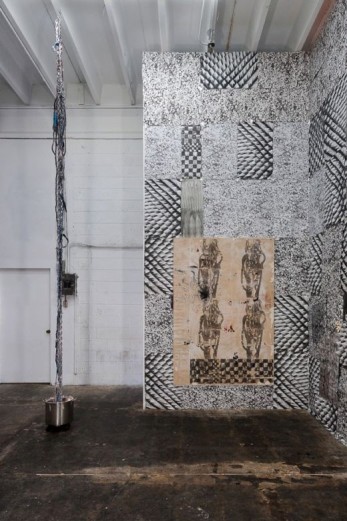
Stepping into the coral-like trove of Solid Single Burner, the LA-based artist JPW3’s solo at Michael Jon Gallery, is like entering a process grotto. There is strong physical and poetic cohesiveness throughout—a transfer of imagery, materials and ideas coupled with literal changes of state as elements dematerialize and incorporate into one another in a self-referential cycle.
Peter Eleey
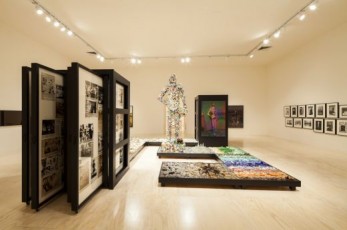
Peter Eleey is Curator and Associate Director of Exhibition and Programs at MoMA PS1 in New York, where he has organized 20 exhibitions, including an expanded version the Mike Kelley retrospective originally organized by the Stedelijk Museum, Amsterdam. Eleey’s much-lauded installation of this exhibition marked the first time that the entirety of PS1’s vast gallery spaces were dedicated to the work of a single artist. Eleey’s current survey of the work of the Austrian painter Maria Lassnig runs through May 25th. Prior to joining MoMA PS1 in 2010, he was Visual Arts Curator at the Walker Art Center in Minneapolis, and Curator and Producer for Creative Time in New York. In town for his talk at Locust Projects on January 16, 2014, Eleey visited artists’ studios and toured the new Pérez Art Museum Miami with René Morales, PAMM Curator. The following interview was conducted on the heels of this visit via email.
Gold and Ice Cream: Two Paths for Colombian Contemporary Art
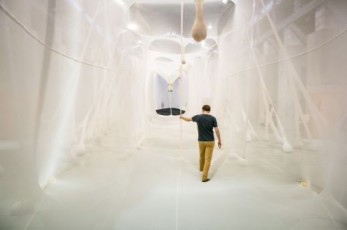
When you visit Bogotá, they tell you to go to the Gold Museum. They tell you to go to the Botero Museum, which is around the corner and shares a courtyard with the Museo del Banco de la República. They tell you to take the funicular up to the church on Monserrate, but you mustn’t move too quickly, because the city itself is 8,661 feet above sea level; in the mountains it’s over 10,000. Yes, many suffer from altitude sickness, which shares its symptoms with the flu, carbon monoxide poisoning, or hangover. While you’re here, you need to drink aguardiente, you need to eat chicharrón, have you visited the Gold Museum? Oh, and don’t get into a cab, or you’ll be kidnapped.
Manuela Moscoso
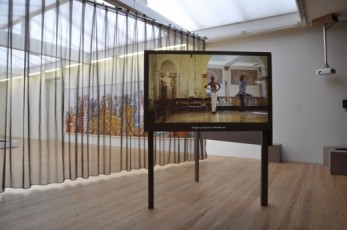
Manuela Moscoso is an independent curator living in Rio de Janeiro. Together with Sarah Demeuse she runs the curatorial office Rivet. Here, The Miami Rail asked SculptureCenter Curator Ruba Katrib to speak to her about conditions surrounding curating in South America.
Who is Tracey Emin Today?
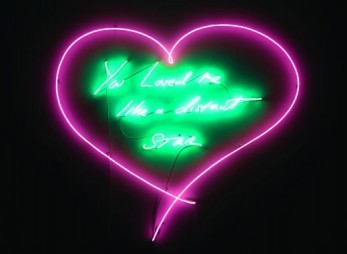
Tracey Emin’s career and life are inextricably conjoined. Her installations, sculptures, drawings and notorious neons from the last two decades are unmediated, honest accounts of her own life. Writing, in many forms, is central to her work and often appears as her own handwriting, the immediacy of which is captured and made permanent in her neons. These are the focus of her solo exhibition Angel Without You (December 4,2013 – March 9, 2014) at the Museum of Contemporary Art, North Miami.