
Category Archives: Visual Arts
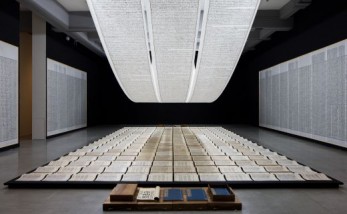
Xu Bing: Writing Between Heaven and Earth
Written on March 6, 2015 at 12:28 am, by Kara Pickman
One of my favorite artworks is Xu Bing’s 1st Class (2011), a rug made from half-a-million cigarettes. They stand leaning against each other on the floor to form a 40-by-15-foot “tiger pelt,” the stripes changing from tobacco-brown to filter-orange as you move around the piece. It is about decadence and death and industry and nature—from the history of the tobacco trade to big game—and it’s a perfect balance of all of these, humorous and serious at the same time.
No Neutral Spaces: Material Art Fair 2015
Written on March 6, 2015 at 12:26 am, by Kara Pickman
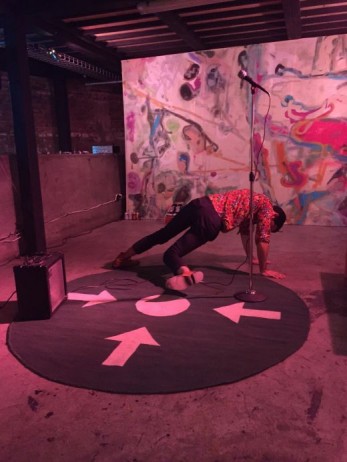
Perhaps no one in Mexico City is more fully engaged with the praxis of merchandise display than the street vendors. Stands hawking nearly identical goods—plastic water guns, cigarette packs stamped with cautionary images of fetuses, striped socks packed in crackling cellophane, and the endless assemblages of Mexican candy (Duvalin, Pulparindo, Lucas Muecas)––are distinguished only by the particular dialogue among the objects. What draws you to this vendor and not to that vendor isn’t a certain stick of gum, it’s the gestalt.
Tara Elizabeth Long: Røle Mødel
Written on March 6, 2015 at 12:21 am, by Kara Pickman
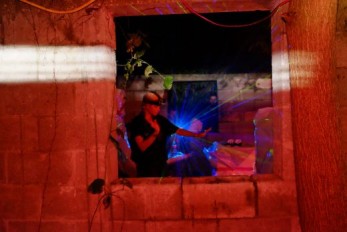
It is a hallmark of grandly chaotic spectacles to be quietly defined by tight parameters, which, though seemingly antithetical to the outcome, actually contribute to the madness of it all. The best example of this might be rules that evolve in children’s playground games: this pole is home base, you can’t run past a building of this color, if you barely brush the chased party, he or she isn’t “it” anymore.
Deborah Kass, Double Yentl (My Elvis) Global Positioning Systems
Written on March 6, 2015 at 12:19 am, by Kara Pickman
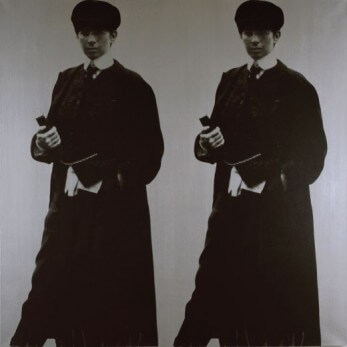
Wander through the galleries on the ground floor of Pérez Art Museum Miami (PAMM), and you can’t miss the imposing, six-foot-tall double painting of Barbra Streisand dressed as a male rabbinical student.
Cecilia Vicuña with Camila Marambio
Written on March 5, 2015 at 6:13 pm, by Kara Pickman
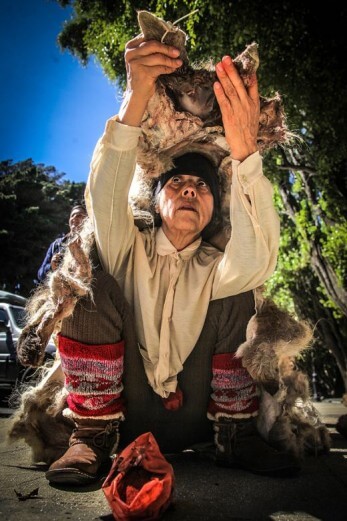
During Cecilia Vicuña’s recent busy visit to Santiago, Camila Marambio spoke with her at her childhood home. The relaunching of her 2006 LP “Kuntur Ko” by the independent New York record label Hueso Records brought her home to offer a series of timely performances and rituals composed in response to the destruction of glaciers in Chile.
Miami: A Driving Tour
Written on March 4, 2015 at 7:46 pm, by Kara Pickman
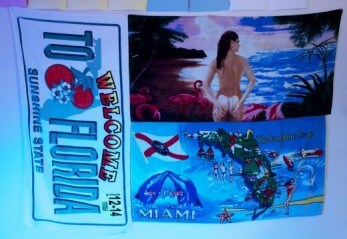
“Don’t walk. Drive.” I can’t count the number of times I was given these instructions while visiting Miami, regardless of how close I was to my destination. I was offered this advice after having parked just a two-blocks’ walk away from Pérez Art Museum Miami to see a pop-up art project nearby.
Perhaps more than anything else, driving my rental car around the city defined my three-day stay in Miami. This marks a significant departure from my typical visit. Like most art tourists and professionals, I head to Miami Beach in December for the fairs, and if I travel around the city, it’s in a cab or art fair shuttle bus. I don’t rent a car, I don’t expect to get around quickly, and I don’t anticipate spending much time on Biscayne Boulevard. During those trips, I spend most of my days studying the floor plans of fairs and my nights blogging from a perch on my hotel bed.
Laddie John Dill, Cayetano Ferrer, Michael Hunter
Written on February 6, 2015 at 5:33 pm, by Kara Pickman
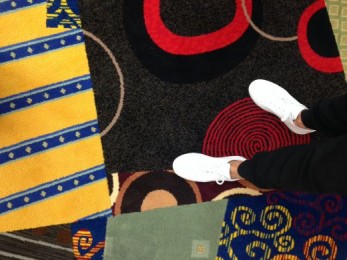
At the opening of Michael Jon Gallery’s group show, someone kept turning off the lights. My wife thought this meant we should leave—but no, dimming the lights only makes for better viewing of Laddie John Dill’s celebrated untitled light work, which he first created in 1971 and has since been (laboriously) installed at the Venice Biennale, among other places. Showcased at the center of the gallery, mounds of sand and sediment house angular arrangements of glass panes that—when someone hits the lights—are softly illuminated from within by argon lighting just beneath the surface.
Mary Reid Kelley with Patrick Kelley, Sadie, the Saddest Sadist and You Make me Iliad
Written on January 23, 2015 at 5:24 pm, by Kara Pickman
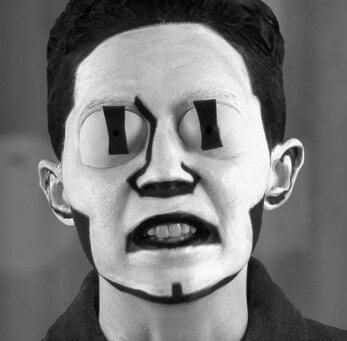
In connection with its current exhibition Myth and Machine: The First World War in Visual Culture, the Wolfsonian–Florida International University hosted artist Mary Reid Kelley for a screening of two of her WWI-inspired videos: Sadie, the Saddest Sadist (2009) and You Make Me Iliad (2010). Reid Kelley is well known for her forceful intellect, expressed in her extremely clever verse-making, biting and playful wordplay, ethereal screen presence, and her filmmaking itself, which entails meticulously researched production details such as drawn imagery, painstaking stop-motion lettering, and costume and set design digitally enhanced by her collaborator and husband Patrick Kelley.
Prospecting
Written on December 3, 2014 at 10:45 am, by Kara Pickman
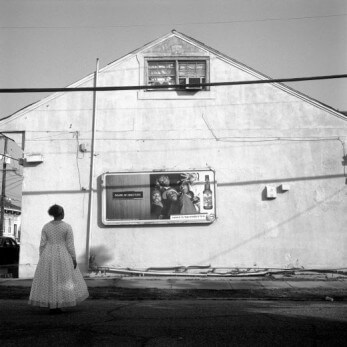
This fall, the PAMM curatorial staff and I took a museum patron trip to New Orleans for Prospect.3: Notes for Now. This is the third installment in a series of large international contemporary art surveys still labeled “biennial” by the organizers, though four years have passed since Prospect 2. The first Prospect, which opened in November 2008, was organized in the aftermath of Hurricane Katrina, in large part as an engine of economic and community development for the devastated city. This edition was organized by Franklin Sirmans, head of contemporary art at the Los Angeles County Museum of Art. In my opinion one of the most talented curators of his generation, he has built a resume heavy on exhibition and publication projects designed to redress the omissions of the Eurocentric Modernist art-historical canon, telling the stories and presenting the artistic achievements of significant yet lesser-known women artists and artists of color from around the world.
Between Two Tomorrows: The 2014 Montreal Biennale
Written on December 3, 2014 at 10:44 am, by Kara Pickman
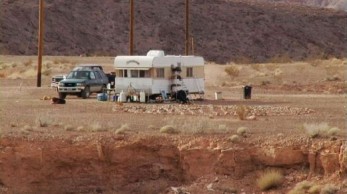
L’avenir (looking forward), the 2014 Montreal Biennale, arises from two perspectives that meet somewhere in the middle. L’avenir is French for what is to come. While that appears to be quite poetic, it could refer to anything between death and the pizza that you just ordered. Looking forward––well, you speak English. We have two conditions of the biennale: the expected object and state, and the expectation itself. Spread out over 14 venues, the biennale comprised 50 artists from 22 countries. Half the artists were from Canada; 16 were from Québec. Although it would be incorrect to reduce the art to a thematic checklist, it seemed that the majority of the pieces held a Janus-faced relationship to both the future and history. This relationship appeared structurally in many of the ongoing research-based projects on display. It also appeared in the content of many pieces explicitly dealing with history.