
Category Archives: Visual Arts
Caribbean: Crossroads of the World
Written on September 13, 2014 at 8:48 am, by Kara Pickman
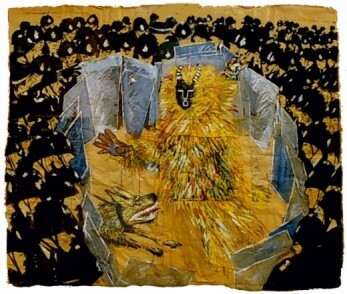
Caribbean: Crossroads of the World, offering a 200-year survey of visual culture from the Caribbean Basin, results from more than a decade of devoted work by curator Elvis Fuentes. Taking as its point of departure the Haitian Revolution (1791-1804)— a pivotal moment that changed the Caribbean’s dynamics with Europe—in the history of the area, the exhibition rejects the reductionist and extended chronological vision of a place where the coexistence, persistence, and overlap of different historic eras is one of the most outstanding endogenous characteristic.
The Beachhead of the Global South
Written on September 13, 2014 at 8:35 am, by Jessalyn Santos-Hall
Much has been said about the ways that Art Basel has transformed Miami’s relationship to the international art world. Once a year in December, when it’s cold and gray in New York, London, and Berlin, the art jet set congregates in the waterfront hotels of South Beach to buy art, talk shop, cut deals, and party hard. Over the last 12 years, the number of fairs has grown from one to around 20, attendance numbers have reached six figures and the cash injection into the local economy is now estimated at over $500 million a year. The media hype stresses the benefits of high-profile culture, which, like it or not, spurs gentrification on the one hand, and public and private investment in local cultural institutions on the other.
Yann Gerstberger, SURFBOARD
Written on September 13, 2014 at 8:33 am, by Kara Pickman
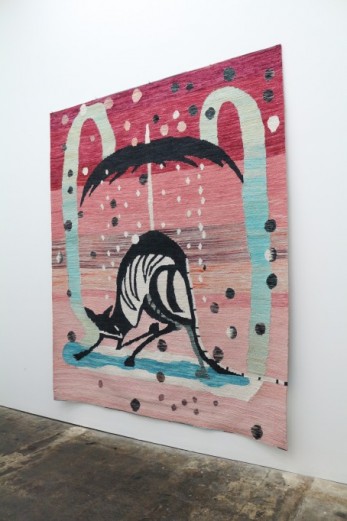
There are two elements of the work in Yann Gerstberger’s recent show that could warrant attention individually: the imagery recalling Miro or Picasso as much as ’80s graphics or ancient, totemic forms; and the work’s material presence as rugs or textiles. Both elements dominate the viewer’s initial encounter. Large rugs of thick strands of dyed mop-head material host mysterious, simple forms in a palette of pinks, magentas, sky blues, whites, tans, and blacks. The atmosphere is warm and light, and the objects suggest ancient modes of making even as they remain obviously contemporary.
Berlin Biennale 8
Written on September 13, 2014 at 8:28 am, by Jessalyn Santos-Hall
Until 2006 it was still possible for the entire Biennale to be hosted inside the KW Institute as well as in vacant buildings in the Mitte neighborhood. But recent development in the neighborhood has forced Biennale’s curators and organizers to expand to venues outside of the city center. While this may have extended travel times between venues, it introduced the artists and audience to parts of the city outside of the expected cultural hubs that have flourished over the years. Most importantly, as noted by Gabriele Horn, Director of KW Institute, it came to reflect the “diversity, social and spatial heterogeneity, dynamism, mobility, and simultaneity of different urban areas that opens up the varied potential for the city’s future and its multiple publics.”
My Journey With Aeroflot: Adventures in the Estonian Contemporary Art World
Written on September 13, 2014 at 8:24 am, by Jessalyn Santos-Hall
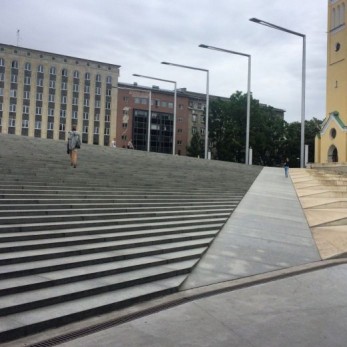
Efficient and peaceful, the Tallinn airport was a marked improvement upon infernal Miami International. The cab driver’s English was better than those in Miami. Come to think of it, everything here seemed better than Miami, especially the weather, which was worse than Miami’s, but simply by being bad offered a change and, with that, excitement. “Nothing is harder to bear than a succession of fair days,” Goethe says. Luckily, with its near-constant cloud cover and regular showers, I didn’t have to worry about that in Tallinn.
Thomas Hirschhorn

Written on September 13, 2014 at 7:57 am, by Jessalyn Santos-Hall
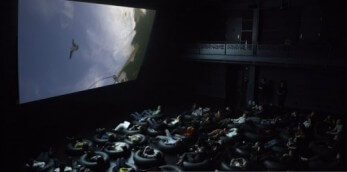
On a rainy day in May, the Miami-based artist Christy Gast and I decided to distract ourselves from working on the exhibition project that had brought us to Paris by going to check out Thomas Hirschhorn’s latest installation Flamme Éternelle at the Palais de Tokyo. It was a welcome surprise, upon entry, to discover that Hirschhorn had chosen to make his exhibition free of charge and had built a structure and a communication/signage system that bypassed the admissions desk and descend directly into the massive sub-floors of the art palace. Steered, as we were, by Hirschhorn’s usual language of cardboard, packing tape, and philosophical slogans, we soon found ourselves in what felt like a jerry-built city constructed almost entirely of tires and where the reigning feeling was “anything goes.”
Leo Gabin’s Florida
Written on September 13, 2014 at 7:36 am, by Jessalyn Santos-Hall
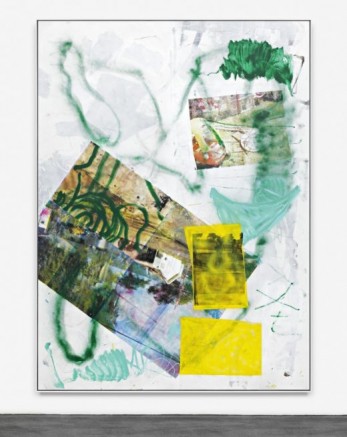
Three Belgian artists, represented by a gallery in Berlin, stage an exhibition in London concerning life in Florida. Chew on that. Chew slowly and hope it stays down. Lieven Deconinck, Gaëtan Begerem, and Robin De Vooght are three multidisciplinary artists who have meshed their names together to form Leo Gabin. For their recent solo exhibition, part of the alternative Inside the White Cube series at White Cube (Mason’s Yard) in London, Leo Gabin addressed Florida as a modern Limbo: where those occupying it lie in wait, in longing but with little hope, for a future above and beyond their current circumstances.
Miami As Idiom
Written on September 13, 2014 at 7:33 am, by Jessalyn Santos-Hall
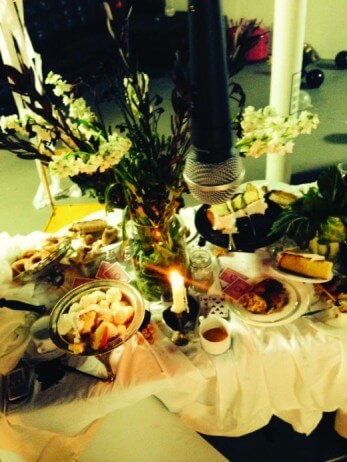
If any city is poised to invent its own idiom, it is here.
In this sprawled out, inconclusive phrasing of a city.
If Miami were punctuation it would be a colon: porous and prophetic.
Toward South Florida Aesthetics: An Oral History of GUCCIVUITTON
Written on September 13, 2014 at 7:32 am, by Jessalyn Santos-Hall
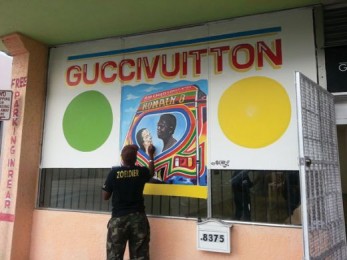
In the spring of 2013, Miami artists Loriel Beltran, Domingo Castillo, and Aramis Gutierrez started a gallery in Little Haiti called GUCCIVUITTON. I didn’t fully get the irony of the name until I attended an almost empty “collectors night” there, hosted by the Museum of Contemporary Art, North Miami. When I asked a museum staff person why it was so sparsely attended, she said “we think a lot of our members drove up, looked at the neighborhood, and kept driving—I mean we’ve had members not come to events because there wasn’t valet, so you can imagine they aren’t ready to stop in Little Haiti!” Despite such collector trepidation, GUCCIVUITTON has mounted some of the most interesting and eclectic exhibitions anywhere, with a sensibility that could only come out of Miami—in fact, that is their stated mission: to explore a colloquial South Florida aesthetic in its many forms. One sweltering afternoon during their Chayo Frank exhibition Gutierrez and Beltran walked me through an oral history of GUCCIVUITTON.
Cara Despain, Cast Set
Written on September 13, 2014 at 7:15 am, by Kara Pickman
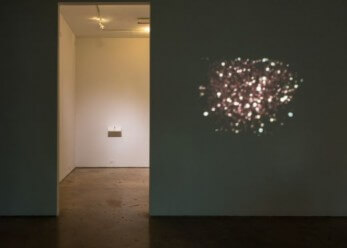
Thanks to growing up in Britain, my knowledge of the American West is largely based on The Lone Ranger television show and John Wayne movies. Luckily, these unimpressive credentials did not impede my ability to make sense of, and appreciate, Cara Despain’s exhibition Cast Set, presented in the project room at Emerson Dorsch. Like most viewers, I was able to access the popular tropes associated with the American West utilized by Despain, which the gallery text describes as being “embedded in our collective psyche.” The idea of a collective psyche strikes me as somewhat suspect, since it assumes a degree of exposure to Western culture (in the global sense) that is by no means universal.